

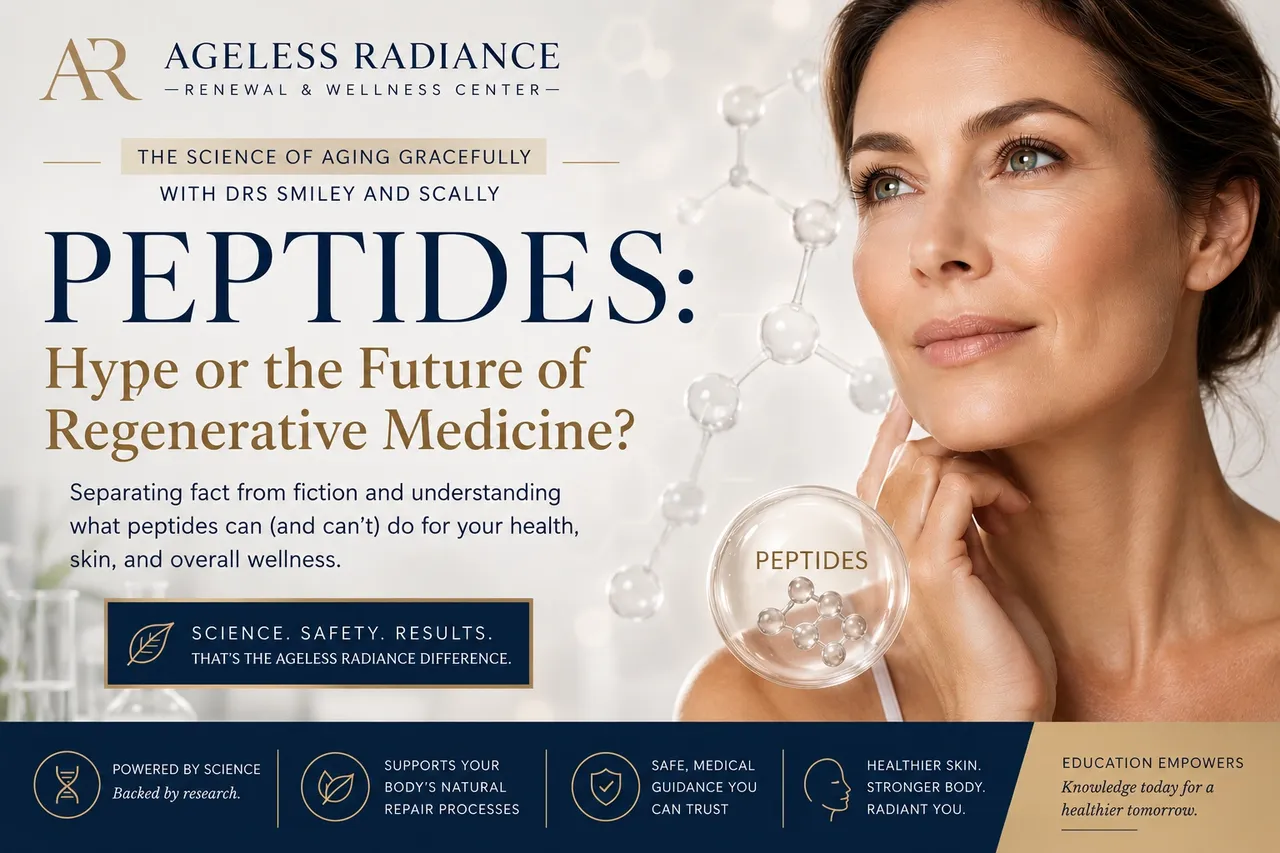
Peptides in 2026: Hype, Hope, and What Patients Need to Know
Medical Update • July 2026
If you've been following health news, you've probably noticed that peptides are everywhere. From social media influencers to medical journals, peptides are being discussed for everything from healthier skin and improved recovery to longevity, metabolism, and regenerative medicine.
Adding to the public interest, the FDA has recently taken several regulatory actions involving compounded peptides, leading many patients to ask:
- "Are peptides now approved?"
- "Are they safe?"
- "Should I be taking them?"
At Ageless Radiance Renewal & Wellness Center, we believe patients deserve clear, balanced, evidence-based information—not sensational headlines. Here's what you need to know.
What Are Peptides?
Peptides are naturally occurring chains of amino acids—the building blocks of proteins. They function as biological messengers, helping regulate many normal processes throughout the body.
Different peptides play different roles, including supporting:
- Skin repair
- Collagen production
- Tissue healing
- Hair follicle health
- Immune function
- Hormone signaling
- Sleep regulation
- Cellular energy production
- Healthy inflammatory responses
As we age, production of many naturally occurring peptides gradually declines. Researchers continue to investigate whether certain peptide therapies may help support normal healing and healthy aging in carefully selected patients.
Why Is Everyone Talking About Peptides?
Interest in peptide therapy has grown dramatically because peptides work differently than many traditional medications.
Rather than simply treating symptoms, researchers are exploring whether some peptides may help support the body's own repair and regenerative processes.
Current areas of investigation include:
- Skin rejuvenation
- Hair restoration
- Muscle and tendon recovery
- Joint support
- Wound healing
- Metabolic health
- Healthy aging
- Cellular energy production
While these areas are promising, research is still evolving. Some peptides have been studied extensively, while others remain investigational.
Understanding the Recent FDA Changes
Recent headlines have suggested that peptides are "back." The reality is more nuanced.
In late 2023, the FDA placed numerous peptides on its Category 2 list, significantly limiting their availability through compounding pharmacies.
Effective April 23, 2026, several peptides were removed from that Category 2 list after the original nominations were withdrawn. In addition, the FDA's Pharmacy Compounding Advisory Committee (PCAC) is reviewing several peptides for potential eligibility for compounding under federal law.
These developments are important—but they do not mean these peptides are FDA-approved medications.
Understanding the difference is essential.
Three Different Regulatory Steps
1. Removal from Category 2
This means the FDA no longer classifies certain peptides under that specific restriction. It does not automatically authorize unrestricted compounding or establish safety and effectiveness.
2. Review for Compounding Eligibility
The FDA's Pharmacy Compounding Advisory Committee evaluates whether certain peptides may be eligible for compounding under Section 503A of the Federal Food, Drug, and Cosmetic Act. The committee provides recommendations to the FDA but does not itself approve medications.
3. FDA Drug Approval
FDA approval requires extensive clinical research demonstrating safety and effectiveness. Most compounded peptides have not completed this approval process and therefore are not FDA-approved drugs.
These are three separate regulatory pathways, and understanding the distinction helps patients interpret news reports accurately.
Which Peptides Are Receiving the Most Attention?
Researchers continue to investigate a number of peptides for potential therapeutic applications.
Among those receiving significant scientific interest are:
- BPC-157 – being studied for connective tissue repair and gastrointestinal healing.
- TB-500 – under investigation for muscle and tendon recovery.
- GHK-Cu (Copper Peptide) – studied for skin remodeling, wound healing, and hair support.
- MOTS-C – being investigated for cellular metabolism and mitochondrial function.
- Semax – researched for cognitive performance and neuroprotection.
- Epitalon – studied for circadian rhythm and healthy aging.
- KPV – investigated for anti-inflammatory properties.
- DSIP (Delta Sleep-Inducing Peptide) – studied for sleep regulation.
- DiHexa – early-stage research into cognitive health.
- LL-37 – investigated for immune modulation and antimicrobial activity.
Each peptide has different biological effects, varying levels of scientific evidence, and different regulatory considerations. Not every peptide is appropriate for every patient.
Peptides and Skin Rejuvenation
One of the most exciting areas of peptide research involves skin health.
Certain peptides appear to stimulate fibroblasts—the specialized cells responsible for producing collagen and elastin.
These proteins help maintain:
- Skin firmness
- Elasticity
- Hydration
- Smooth texture
- A youthful appearance
For this reason, peptide technology has become increasingly common in medical-grade skincare products and regenerative treatment protocols.
When combined with procedures such as microneedling, fractional CO₂ laser resurfacing, platelet-rich plasma (PRP), or other collagen-stimulating treatments, peptide-based products may complement the skin's natural healing process.
Why Physician Guidance Matters
One unintended consequence of previous regulatory restrictions was the growth of an online "gray market," where peptides could be purchased without medical oversight.
Products sold through unregulated websites may vary in purity, sterility, concentration, and quality.
Patients should be cautious about obtaining injectable peptides from internet vendors or products marketed solely for "research purposes."
Whether peptide therapy is appropriate depends on an individual's medical history, medications, treatment goals, and current scientific evidence.
The Ageless Radiance Philosophy
At Ageless Radiance Renewal & Wellness Center, our approach is guided by one simple principle:
Science should guide treatment—not marketing trends.
We believe every patient deserves honest discussions about what is known, what remains under investigation, and what treatments are most appropriate for their unique goals.
When discussing regenerative medicine—including peptides—we focus on:
- Individualized patient evaluation
- Evidence-informed recommendations
- Realistic expectations
- Patient safety
- Ethical medical practice
Healthy aging is rarely achieved through a single treatment. Rather, it is the result of a comprehensive approach that may include healthy lifestyle choices, medical-grade skincare, collagen-stimulating procedures, regenerative therapies, and ongoing preventive care.
Dr. Smiley's Clinical Insight
One of the questions I hear most often is:
"Are peptides the future of medicine?"
The honest answer is that peptides represent one of the most exciting areas of modern regenerative medicine, but they are not miracle cures.
Throughout more than four decades of caring for patients, one lesson has remained constant:
Medicine advances through careful scientific investigation—not headlines or social media trends.
As research continues to evolve, peptide therapy may become an increasingly valuable tool for selected patients. However, every treatment should be based on sound medical judgment, current scientific evidence, and individualized patient care.
Interested in Learning More?
If you have questions about regenerative medicine, healthy aging, or the latest advances in aesthetic treatments, we invite you to schedule a consultation with Ageless Radiance Renewal & Wellness Center.
Together, we'll explore evidence-based options designed to help you look refreshed, feel confident, and age with vitality.
Important Medical Disclaimer
This article is intended for educational purposes only and should not be interpreted as medical advice. Regulatory policies regarding compounded peptides continue to evolve. Removal of a peptide from an FDA administrative category or review for potential compounding eligibility does notconstitute FDA approval of that peptide as a drug. Treatment decisions should always be made in consultation with a qualified healthcare professional who can evaluate your individual medical history, goals, and current scientific evidence.

