

Beyond Wrinkles: Why Facial Aging Is More Than Skin Deep
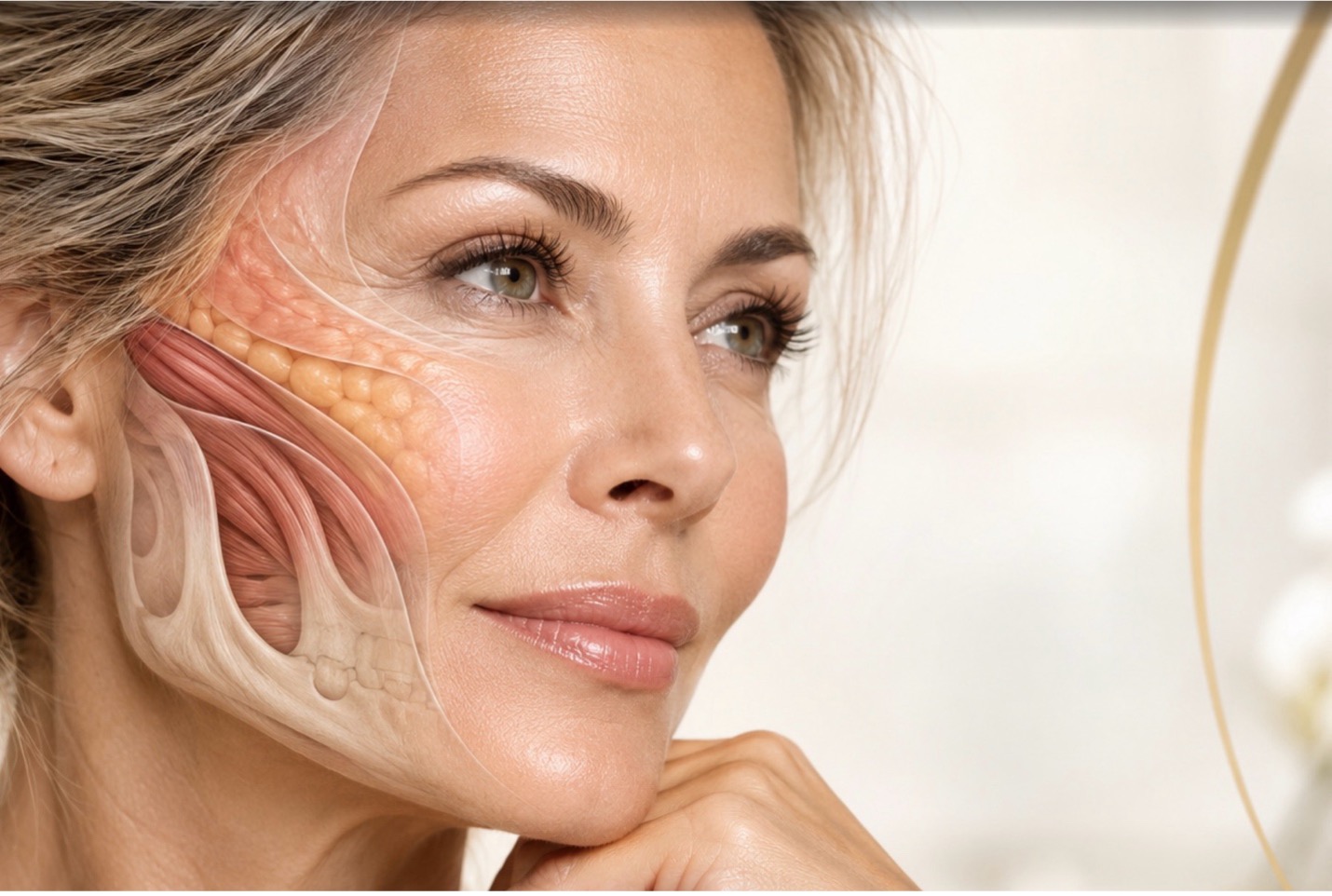
Understanding how changes in skin, fat, muscle, and bone shape the aging face—and why facial rejuvenation should be customized to the individual.
When we think about facial aging, wrinkles are often the first thing that comes to mind. Fine lines around the eyes, deeper folds around the mouth, and changes in skin texture are certainly visible signs of aging—but they tell only part of the story.
The face ages in layers.
Over time, changes occur not only in the skin, but also in the collagen-rich supporting tissues, facial fat compartments, muscles, ligaments, and even the underlying facial bones. These changes occur at different rates in different people, which is one reason two people of the same age may look remarkably different.
Understanding these layers is important because effective facial rejuvenation is rarely about treating a single wrinkle. It is about identifying what has changed, where it has changed, and which treatment is right for that layer of the face.
Layer One: The Skin
The skin is the part of facial aging that we see most easily.
With age, collagen and elastin production decline. Skin becomes thinner and less resilient, while years of ultraviolet exposure can contribute to uneven pigmentation, roughness, fine lines, and changes in overall skin quality.
Lifestyle and environmental factors can accelerate these changes. Sun exposure, smoking, nutrition, hormonal changes, stress, and genetics can all influence how quickly the skin appears to age.
This is why improving the surface of the skin may require a different approach from lifting deeper tissue or replacing lost facial volume.
Depending upon the individual's skin type and concerns, treatments such as fractional CO₂ laser resurfacing, RF micro-needling, IPL, micro-needling, and other energy-based therapies may be considered to improve skin texture, pigmentation, collagen production, or firmness.
Importantly, treatment selection should also account for skin tone. Certain laser and light-based procedures require caution in patients with darker skin because of the increased risk of post-inflammatory hyperpigmentation.
Layer Two: Facial Fat and Soft Tissue
A youthful face does not simply have "more fat." Facial fat is organized into distinct compartments that contribute to contour and support.
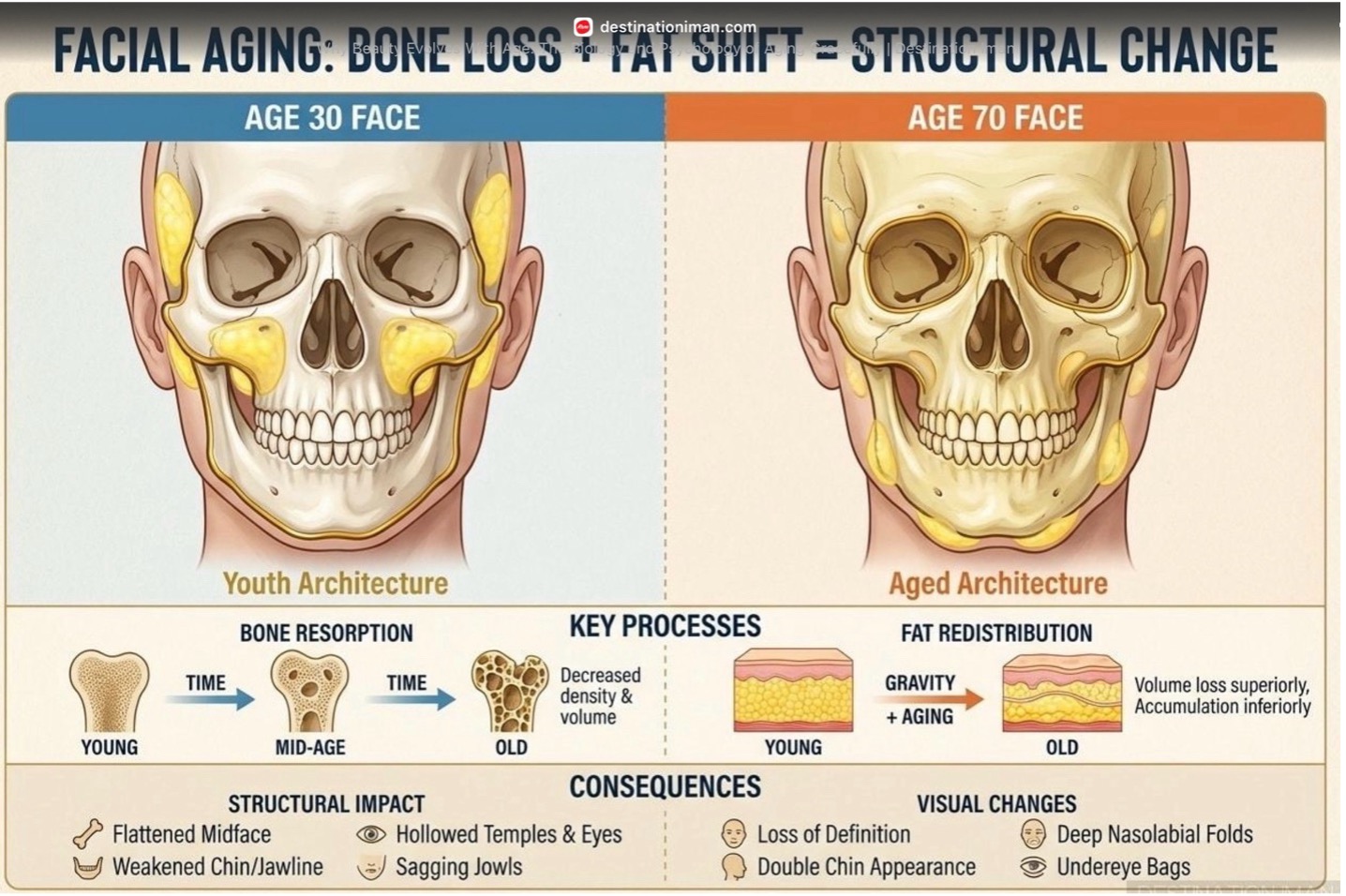
As we age, these compartments can change in both volume and position. Some areas lose volume, while others may descend or become more prominent.
This can contribute to changes such as
This distinction is important because facial aging cannot always be corrected simply by adding volume.
Strategically placed dermal filler may restore volume in selected areas, but volume replacement should be performed thoughtfully. The goal should not necessarily be to make the face "fuller." It should be to restore proportion, balance, and appropriate structural support.
Layer Three: Muscles and Facial Expression
Our facial muscles are constantly working.
Every smile, squint, frown, and raised eyebrow involves muscle movement beneath the skin. Over many years, repeated movement can contribute to dynamic lines such as forehead lines, crow's feet, and lines between the eyebrows.
Neuromodulators such as Botox®, Letybo®, and Daxxify® work differently from fillers. Rather than adding volume, they temporarily modify selected muscle activity.
This distinction is fundamental.
A wrinkle caused primarily by repeated muscle contraction should not necessarily be treated in the same way as a fold caused by volume loss or tissue descent.
Muscle activity can also influence areas that patients may not immediately associate with neuromodulators, including the lower face, jawline, neck, and masseter region. Careful assessment of facial movement can therefore be just as important as examining the face at rest.
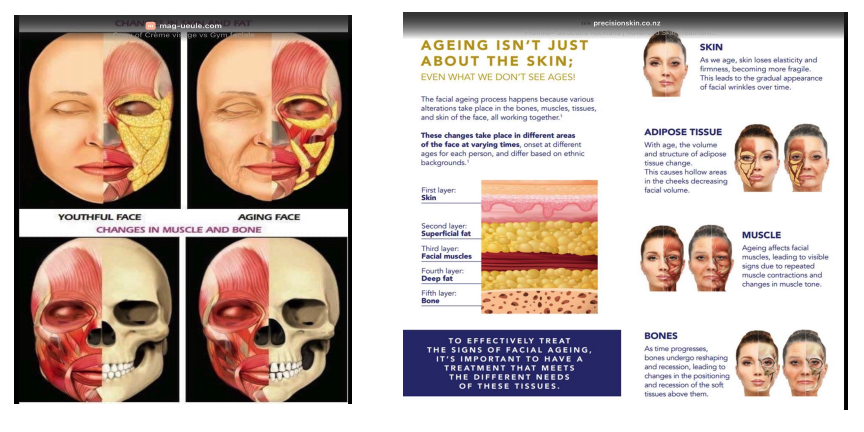
Layer Four: The Facial Skeleton
Perhaps the least understood aspect of facial aging is that our facial bones age too.
The facial skeleton provides the framework supporting the overlying muscles, fat, and skin. With age, gradual changes in bone volume and shape can occur in areas including the eye sockets, midface, maxilla, and mandible.
As skeletal support changes, the soft tissues resting above it may also appear different.
For example, age-related changes around the orbit can contribute to the appearance of the eyes and surrounding tissues. Changes in the midface can affect cheek support, while changes involving the jaws can influence the lower facial contour.
This helps explain why facial aging is not simply a matter of loose skin.
The skin is the outer covering of a complex three-dimensional structure—and every layer beneath it contributes to what we ultimately see in the mirror.
Why More Filler Isn't Always the Answer
Dermal fillers can produce beautiful results when they are used for the right indication. But not every sign of facial aging represents volume loss.
If the primary issue is skin laxity, adding additional volume may not address the underlying problem. If the concern is dynamic muscle activity, a neuromodulator may be more appropriate. If skin texture and collagen loss predominate, resurfacing or collagen-stimulating treatments may deserve greater consideration.
And when several layers have changed, a combination approach may provide a more balanced result than relying on a single treatment.
The objective should not be to chase every wrinkle or erase every sign of age.
It should be to understand the anatomy producing the concern and select treatments accordingly.
Where Do HIFU and RF Microneedling Fit?
Modern aesthetic treatments allow us to target different tissue depths without necessarily performing surgery.
High-Intensity Focused Ultrasound (HIFU) delivers focused ultrasound energy at selected depths beneath the skin. The resulting thermal effect is designed to stimulate tissue contraction and collagen remodeling.
RF micro-needling, including technologies such as Morpheus8 Burst and Burst Deep, combines micro-needling with radio-frequency energy delivered beneath the skin. Depending upon treatment depth and settings, it can be used as part of a strategy to address skin quality, collagen remodeling, and selected areas of tissue laxity.
These treatments are not interchangeable, nor is every patient a candidate for every technology.
The anatomy of the treatment area, skin type, degree of laxity, facial volume, previous procedures, and desired outcome should all influence treatment planning.
Combination Treatment: Treating the Face as a Whole
Because facial aging occurs at multiple levels, carefully selected combination therapy may be appropriate for some patients.
For example, one person may benefit primarily from improving pigmentation and skin texture. Another may require treatment of dynamic muscle activity. Someone else may have skin laxity combined with facial volume loss.
A treatment plan might therefore incorporate different modalities over time rather than attempting to accomplish everything during a single appointment.
This is also why comparing your treatment plan with a friend's treatment plan can be misleading. Even if you are the same age, your facial anatomy, skin quality, bone structure, pigmentation, muscle activity, and pattern of aging may be remarkably different.
Natural Rejuvenation Begins with Anatomy
There is no single procedure that "reverses aging."
There are, however, increasingly sophisticated ways to address the individual changes that occur as the face ages.
At Ageless Radiance Renewal & Wellness Center, our philosophy is to evaluate the face as a three-dimensional anatomical structure rather than focusing on an isolated wrinkle.
Dr. Alayna B. Smiley is an Oral & Maxillofacial Surgeon whose training includes the anatomy of the face, jaws, and surrounding structures. This anatomical perspective informs an individualized approach to facial rejuvenation.
Our goal is not to make every patient look the same—or to make someone look like a different person.
It is to help patients keep and enhance the features that make their faces uniquely their own.
Ready to Learn What Your Face Actually Needs?
A consultation allows us to evaluate your skin quality, facial proportions, volume distribution, muscle activity, and areas of concern before recommending treatment.
Treatment recommendations may include energy-based skin treatments, RF micro-needling, HIFU, neuromodulators, dermal fillers, PDO threads, resurfacing, or a carefully planned combination of modalities based upon individual needs.
Ageless Radiance Renewal & Wellness Center
McLean, Virginia
Schedule a consultation at AgelessRadiance.org
Individual results vary. Not every treatment is appropriate for every patient. A consultation and medical assessment are necessary to determine appropriate treatment options.

